Resources 2026

Restaurant operations management: the levers that make the difference in 2026

Food cost, labor cost, waste, real-time steering: how top restaurant networks optimize their operations management in 2026. Tools and quantified use cases.

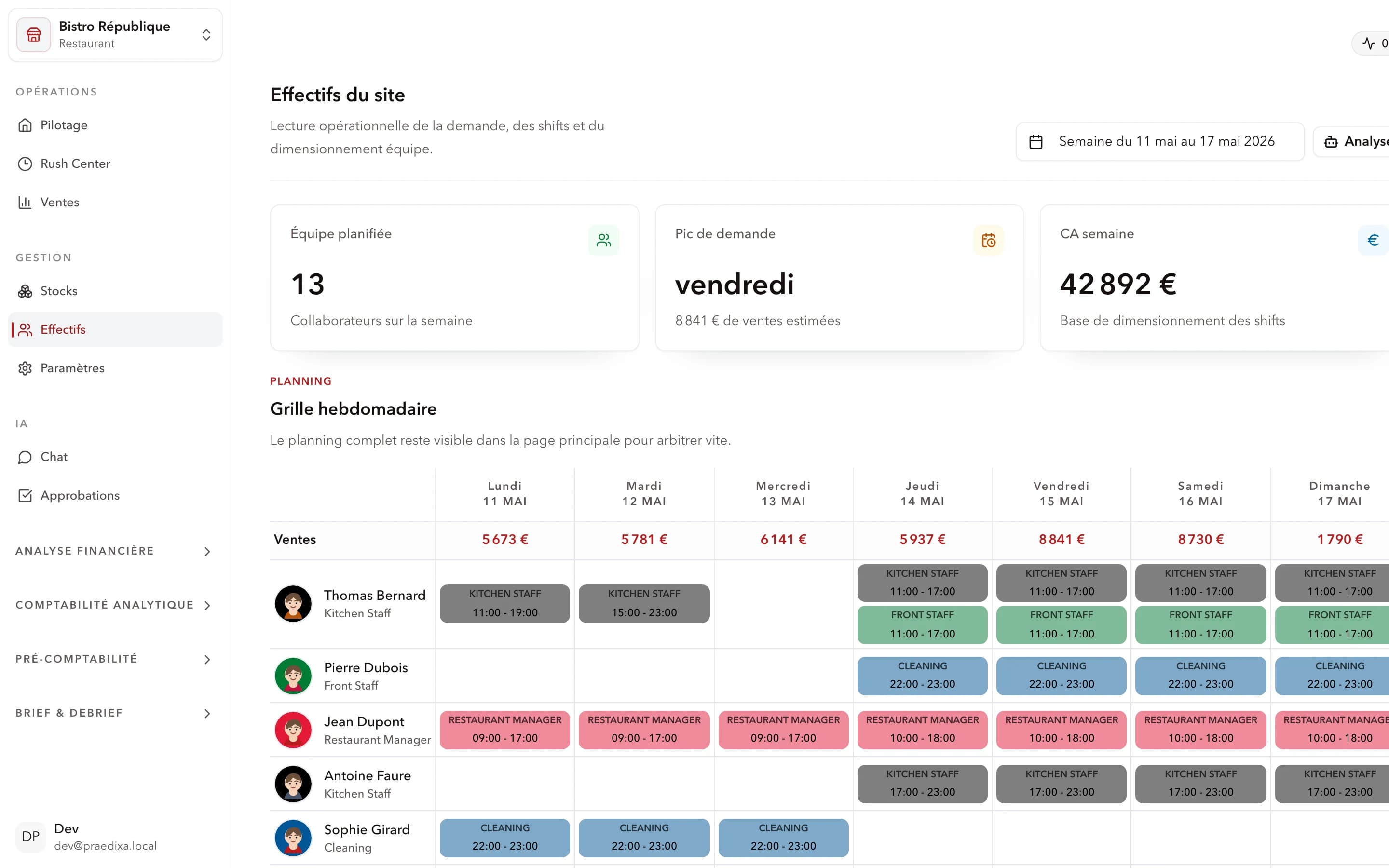
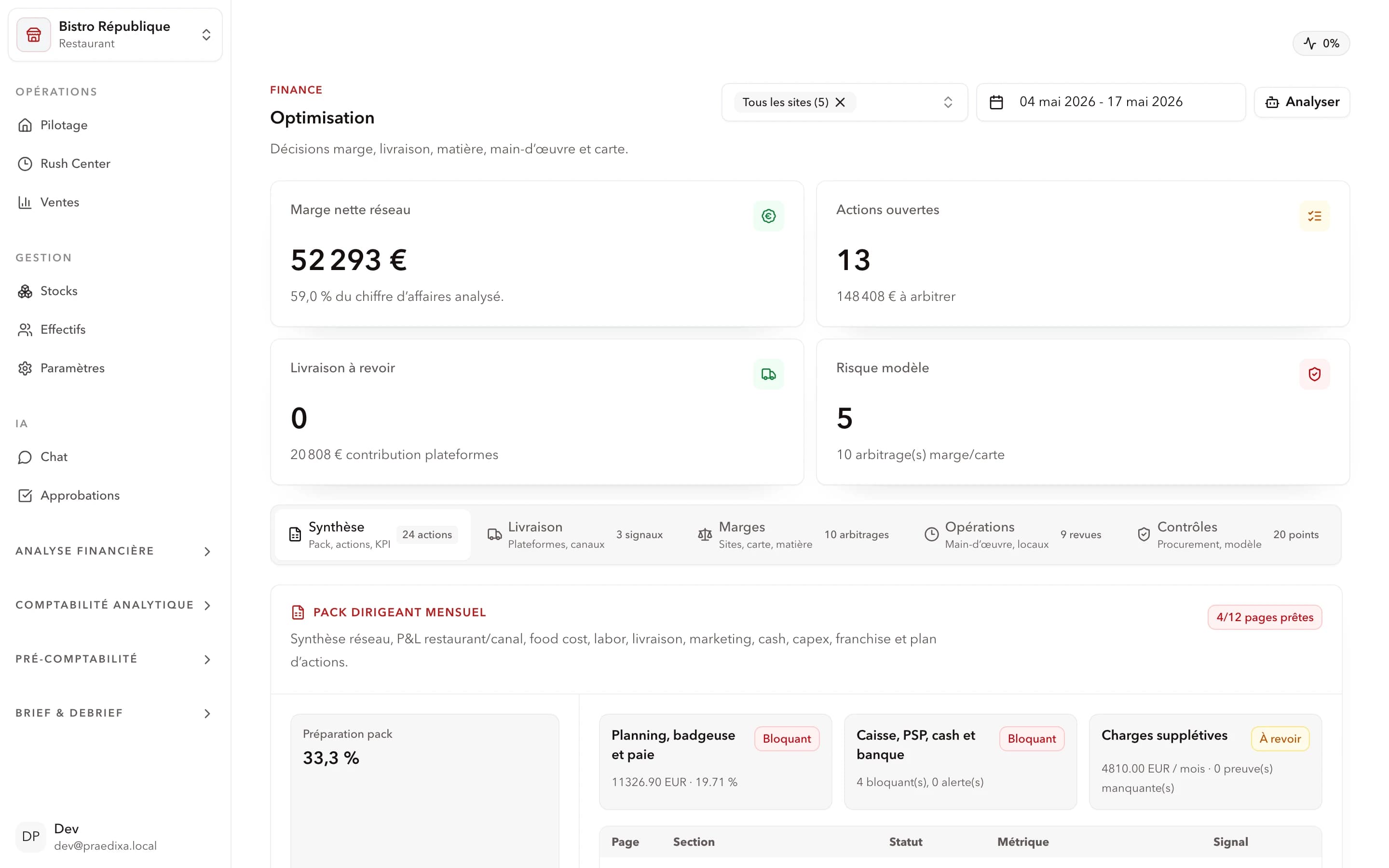
Praedixa operations dashboard with real-time KPIs and forecast-vs-actual variance
Praedixa operations dashboard: real-time site KPIs with forecast-vs-actual variance and targeted alerts.

What is restaurant operations management?

Restaurant operations management is the set of processes that allow a restaurant or network to operate profitably day to day. It covers four areas: demand forecasting, inventory management, labor planning and real-time steering. It is what happens between Monday-morning supplier orders and Saturday-night closing.

  • Maintain a food cost between 25 and 35% of revenue depending on the format.
  • Keep prime cost (food + labor) below the critical 60% threshold.
  • Detect drifts at D+1 instead of at the monthly close.
Method

How to read this restaurant operations management: the levers that make the difference in 2026 comparison

This guide is built for an operational decision, not for a feature checklist. In foodservice, day-to-day restaurant operations management should be assessed by its ability to turn existing operational data into concrete tradeoffs: buying slightly less, reinforcing a team before a rush, preventing a likely stockout or protecting margin on a sensitive service.

The first question is therefore not simply: which tool has the best dashboard? The real question is: which tool helps a manager, franchisee or operations team decide before the issue is visible in the POS data? A good solution should connect POS, sales history, calendar, weather, inventory and scheduling data without forcing teams to replace their entire stack.

Praedixa focuses on an immediate operational challenge: forecasting demand and labor needs more accurately to reduce waste, stockouts, food cost and scheduling errors. The goal is simple: help teams make better decisions before service, with a measurable impact on margin.

Operational performance 2026

The 4 pillars of operational performance

Food cost under control. The cost-of-goods / revenue ratio should stay between 25% and 35% depending on the format. Beyond that, every drift point amounts to thousands of euros lost monthly.

Labor cost in check. The standard labor cost ratio sits between 30% and 38% of revenue. Combined with food cost, prime cost should not exceed 60% — the critical threshold in 2026.

Zero stockouts, zero waste. Poorly-managed inventory costs twice: stockouts drive guests away, waste goes in the trash. Each recovered point of loss represents around €140/month for a restaurant with €14,000 monthly purchasing.

Field reactivity. Detecting a drift at D+30 in monthly close is too late. Top operators correct at D+1, sometimes mid-service.

Why operations management is more complex multi-site

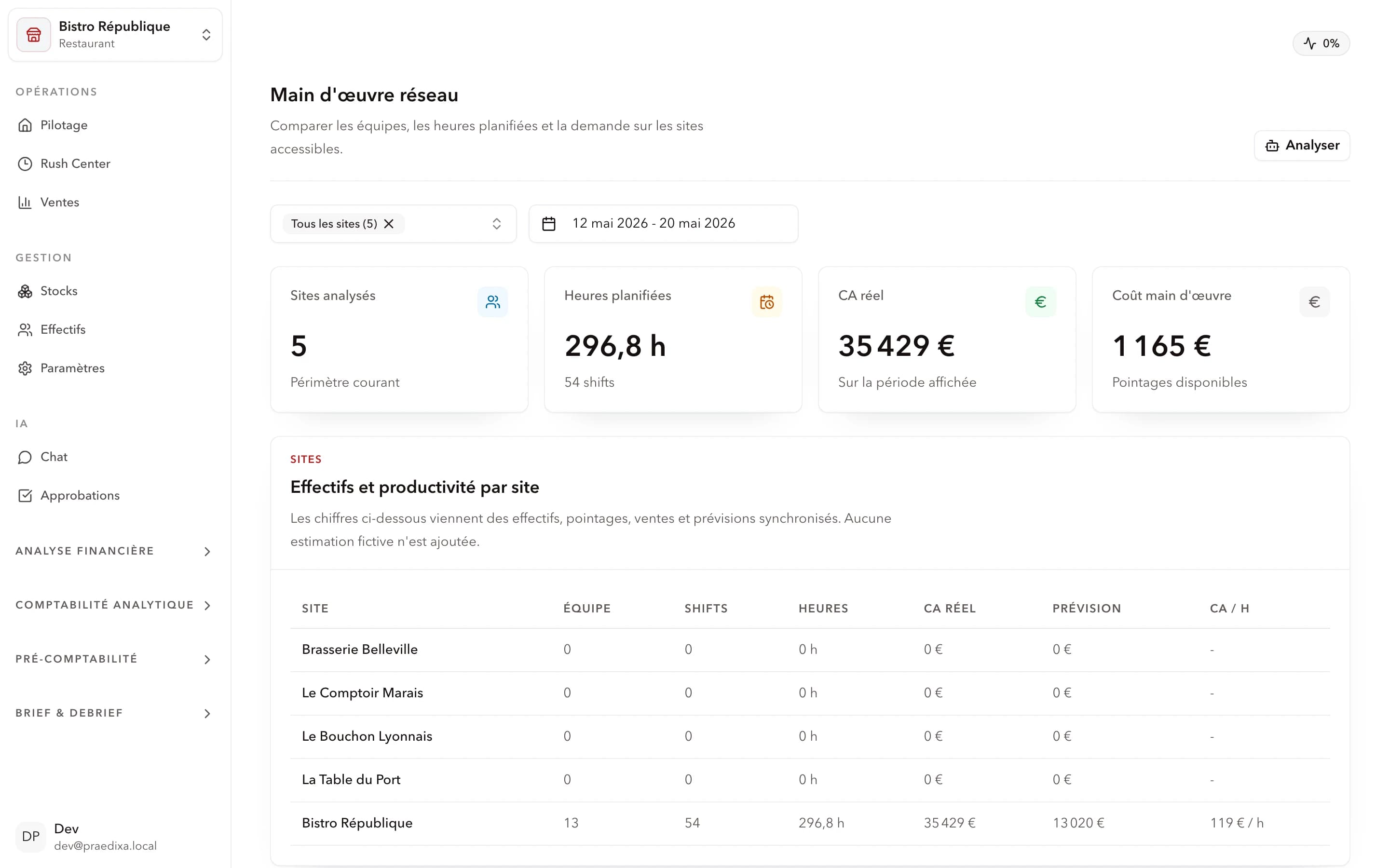
A single site is already complex. A network of 10, 20 or 50 restaurants is another dimension. Multi-site challenges include heterogeneity across sites, the impossibility of manual monitoring, HCR compliance across every location, central purchasing vs local inventory, and dozens of parallel schedules. See multi-site restaurant management for the dedicated playbook.

Lever 1 — Demand forecasting: anticipate before you act

Demand forecasting is the foundational lever. Everything else depends on it: supplier orders, schedules, kitchen production. Without a reliable forecast you order too much or too little, schedule too many or too few, produce for covers that don't come.

What demand forecasting concretely enables:

  • Anticipate peaks (events, weather, holidays) at D-7 to D-14
  • Adjust supplier orders before delivery, not after
  • Calibrate kitchen production tightly
  • Reduce food waste by 15–30%
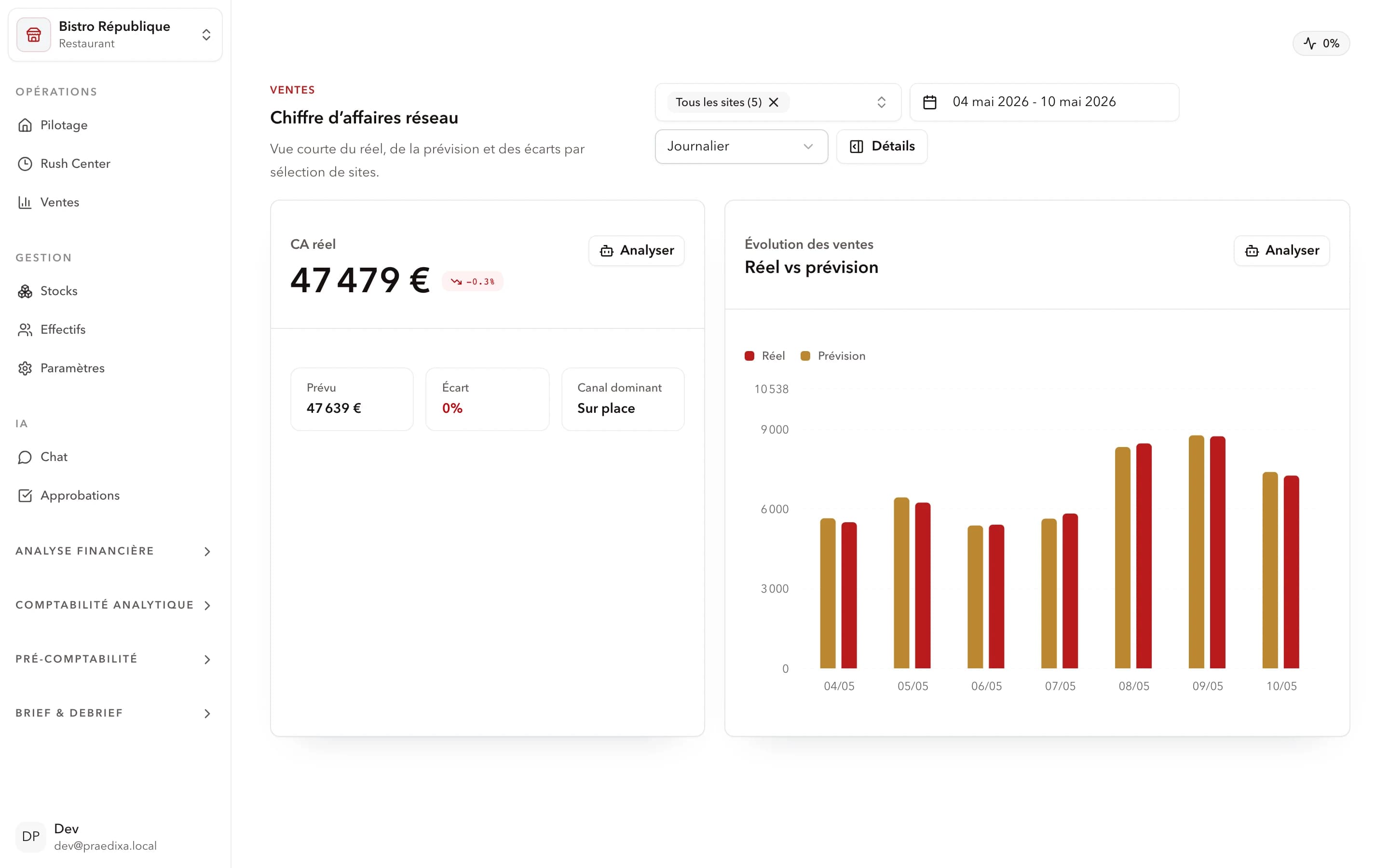
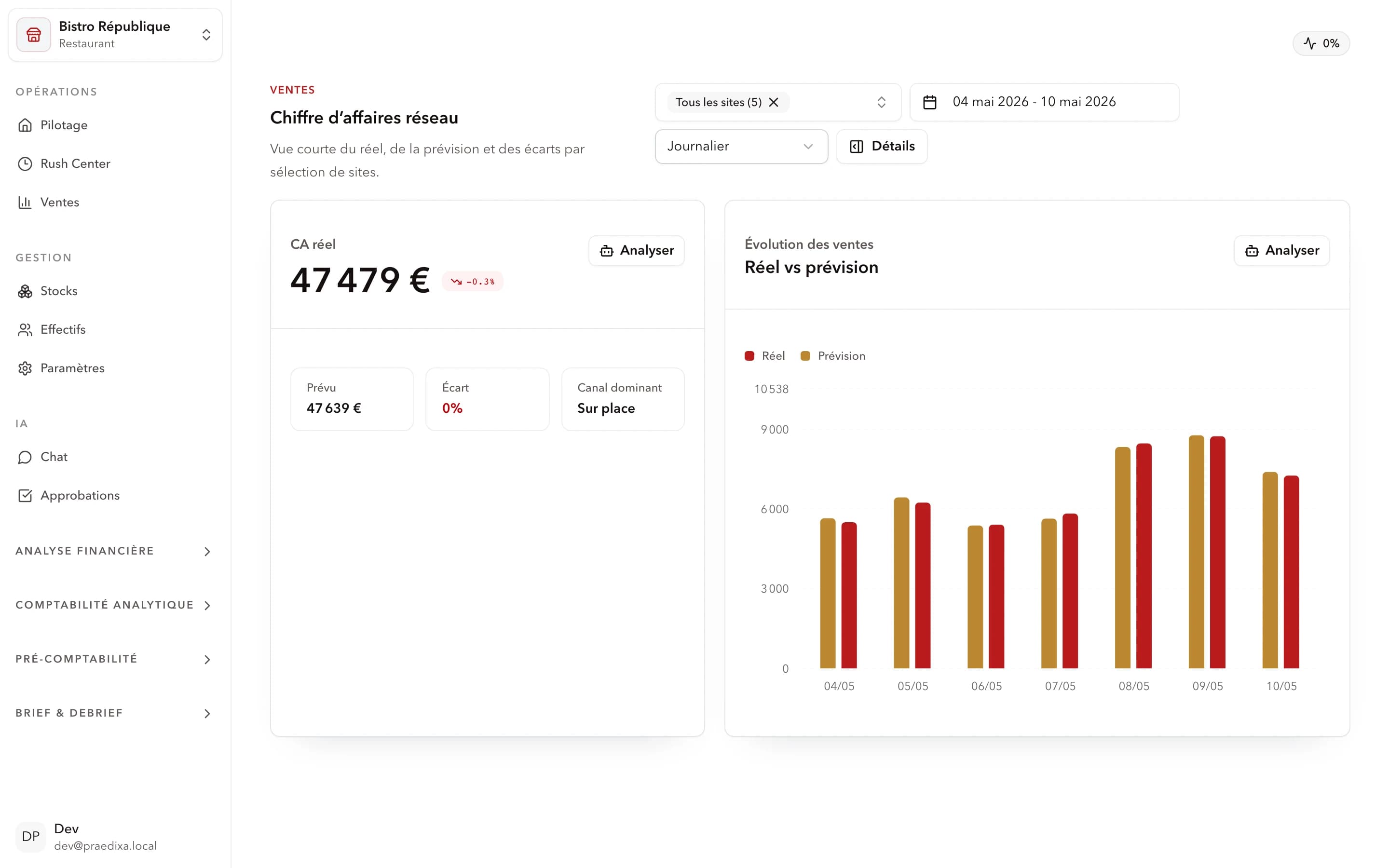
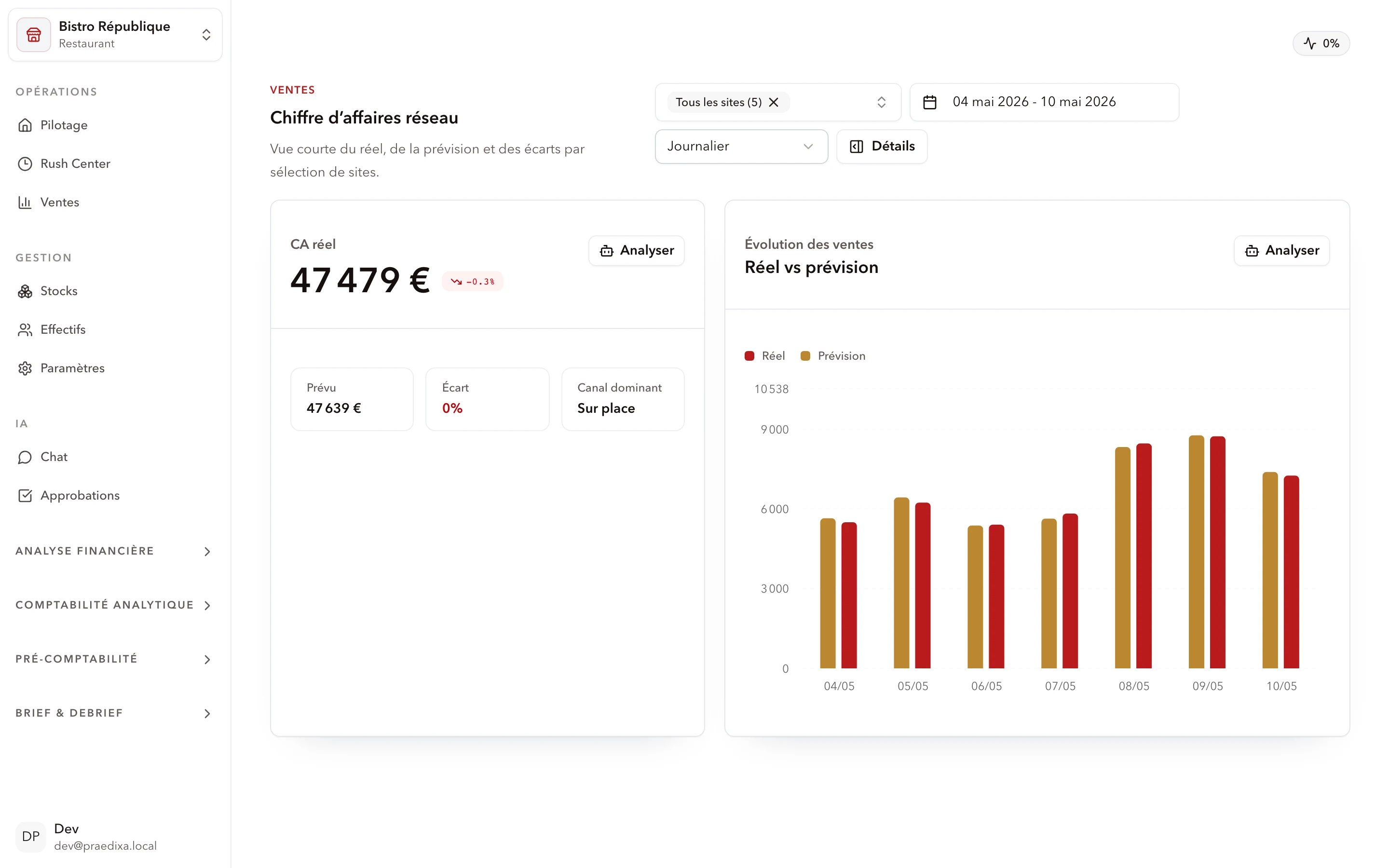
Praedixa demand forecast chart with actual vs predicted per site and per day
Praedixa forecast — actual vs predicted across a network, per site and per day with residual variance per service.

Lever 2 — Inventory: zero stockouts, zero waste

Restaurant inventory management is one of the quietest loss centers. Nobody sees waste accumulate until month-end close.

Operational best practices:

  • Weekly inventory on high-rotation items (meat, fish, fresh produce)
  • Recipes with precise gram-level specifications
  • Automatic reorder thresholds per site
  • Expiration alerts before perish

Lever 3 — Labor planning: align teams with demand

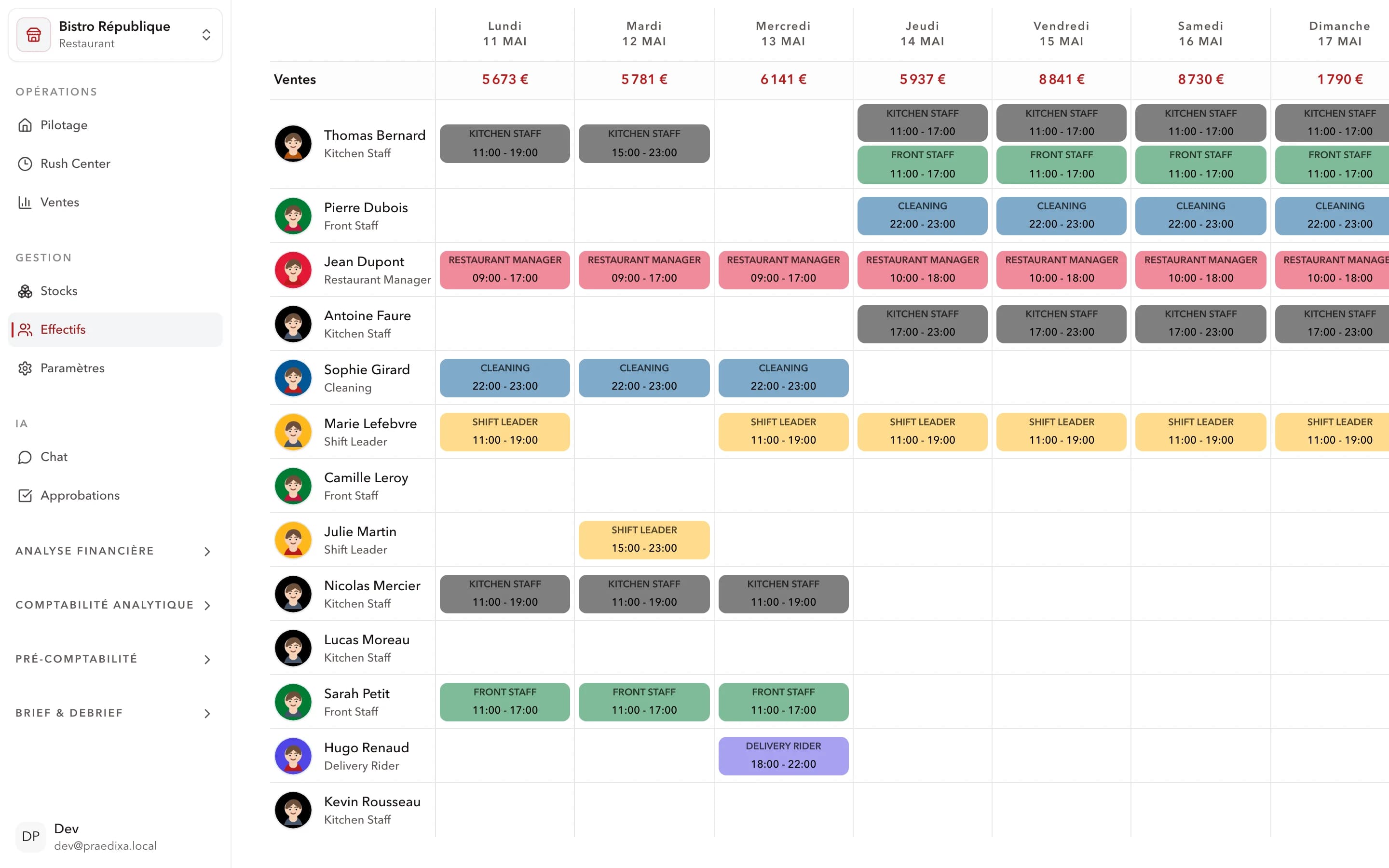
Labor shortages make every worked hour precious. Scheduling on intuition is waste. The challenge: align labor to actual demand, service by service. Not on habit. A restaurant scheduling software wired into forecasting automates that alignment.

What smart scheduling delivers:

  • Reduced unplanned overtime
  • Automatic compliance with collective bargaining (rest, legal limits)
  • Anticipated temp needs at D-5 rather than D-1
  • Productivity measured as revenue per worked hour

Lever 4 — Real-time steering: decide fast, correct early

Real-time operational steering is the difference between reacting and acting. A restaurant detecting a food cost drift at D+1 can correct immediately. One waiting for monthly close has already lost 4 weeks of margin.

KPIs to monitor in real time:

  • Food cost per site and product family
  • Prime cost (food + labor) vs target
  • Occupancy per service
  • Forecast vs actual variance (covers, revenue)
  • Critical stock alerts
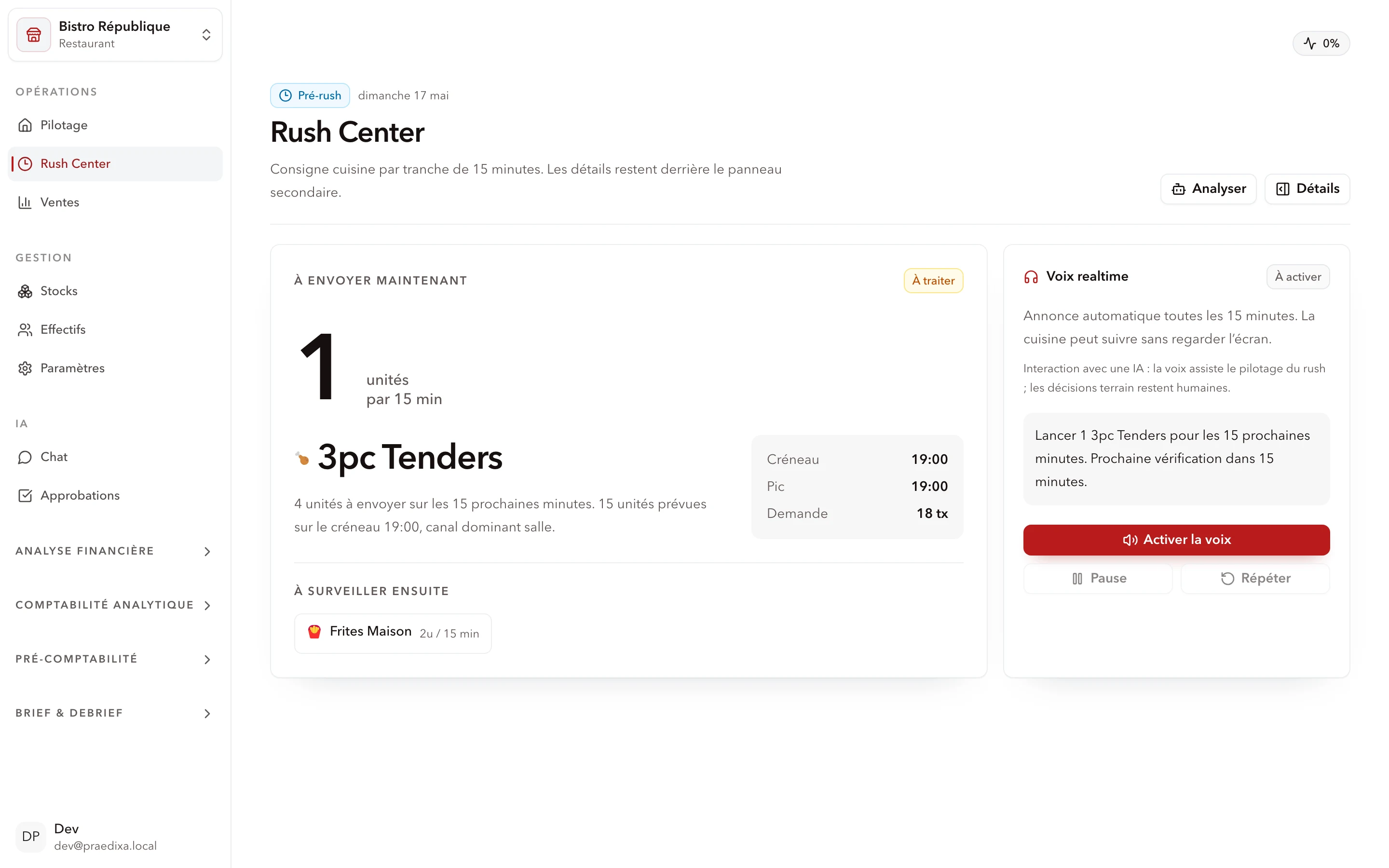
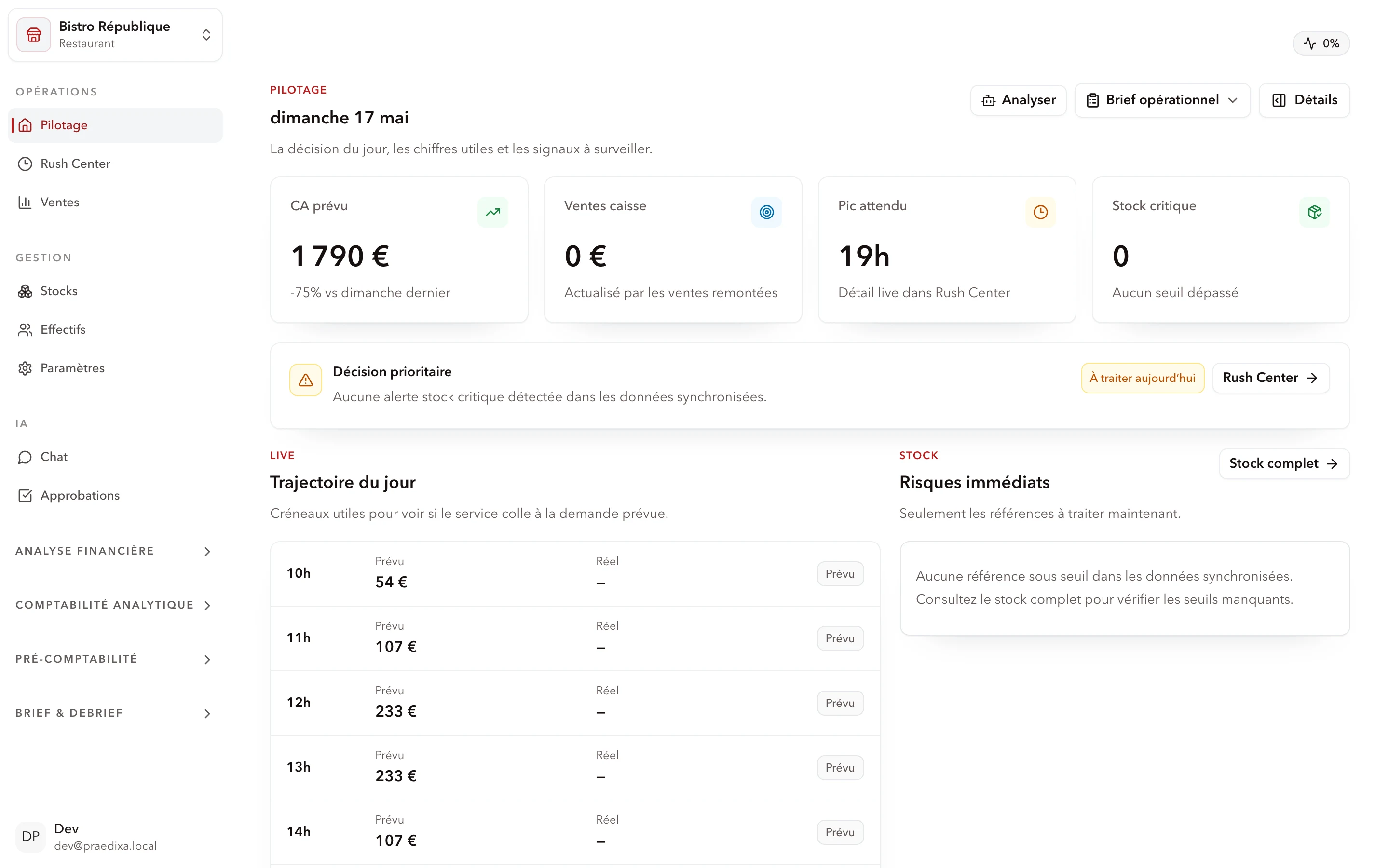
Praedixa Rush Center with service windows, real-time recommendations and field alerts
Praedixa Rush Center — intraday service management with real-time recommendations and field alerts.

Use case — 15-restaurant network, −22% operating costs in 90 days

Context: a 15-site quick-service network in France, run by a central team of 4. Consolidated monthly revenue: around €1.2M. Model: franchise, standardized menu, centralized purchasing.

The problem: Before Praedixa, the operations director steered with weekly Excel exports consolidated manually.

  • Average food cost at 38% — 3 points above target
  • Labor cost at 41% — prime cost at 79%, in danger zone
  • 3–4 sites in permanent drift, detected too late
  • Supplier orders built from habit, not actual demand
  • Waste estimated at 8% of purchased volume
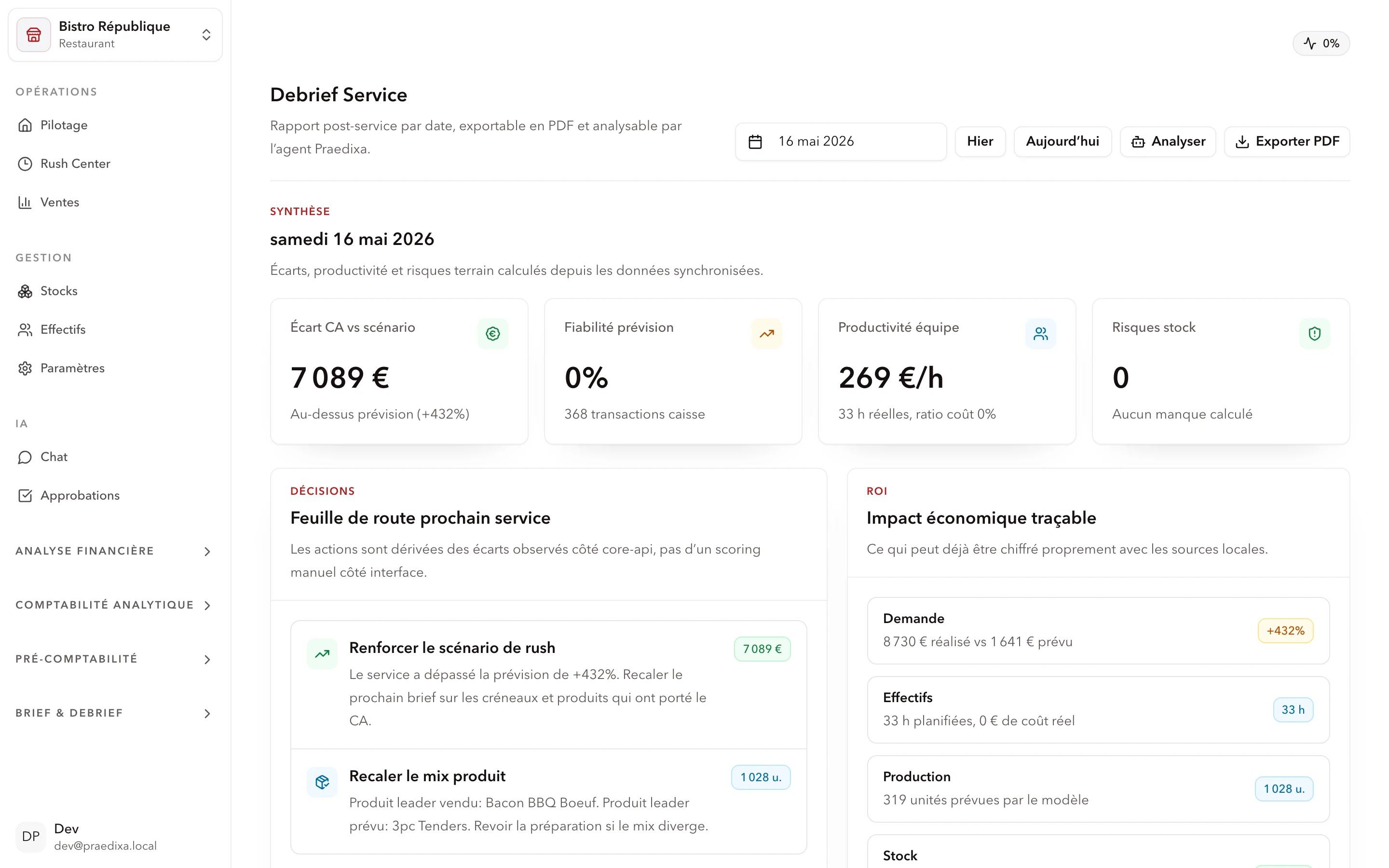
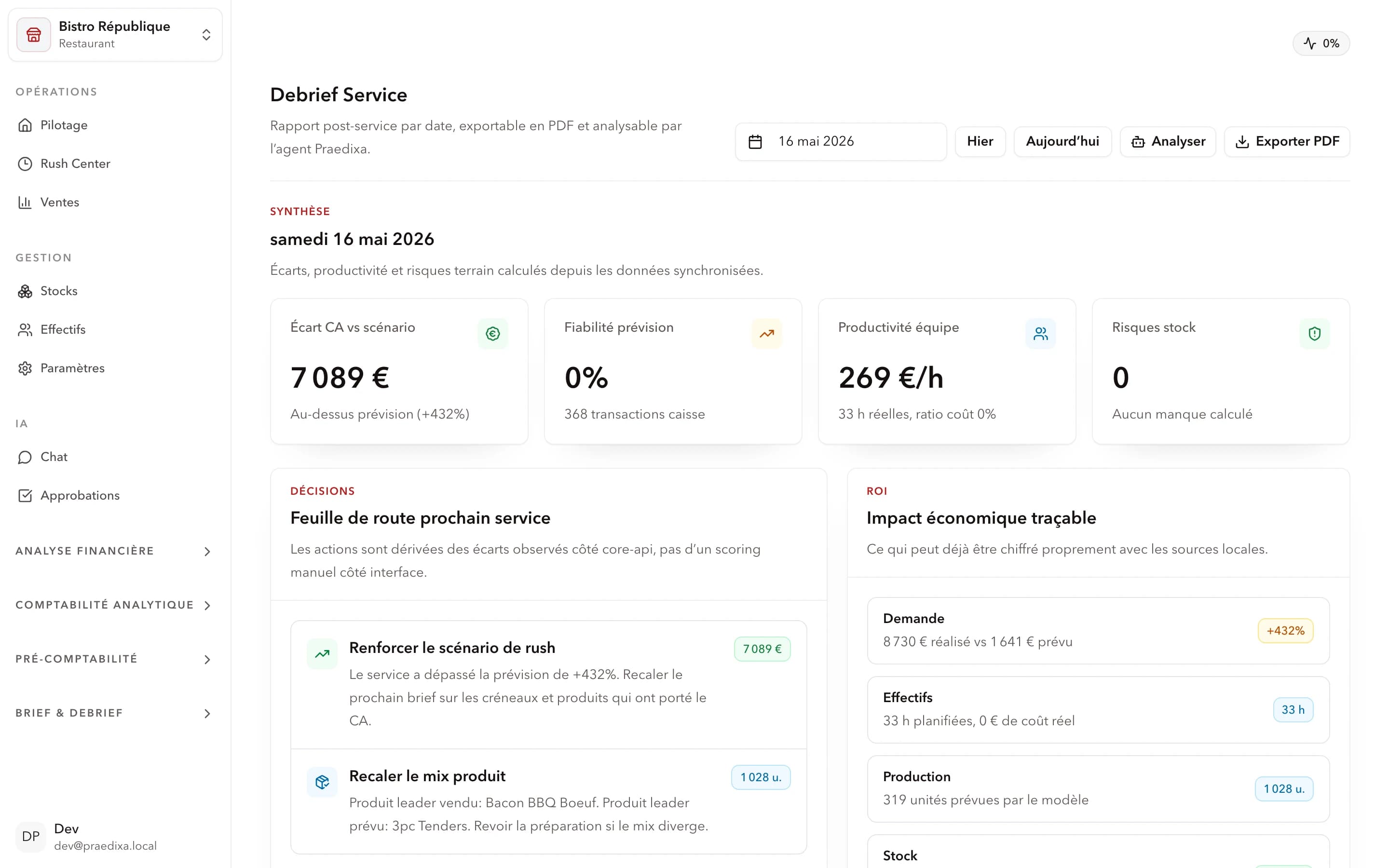
Praedixa service debrief with revenue variance, transactions, productivity and per-service ROI
Praedixa service debrief — post-service analysis with revenue variance, hourly productivity and ROI indicators.

What changed with Praedixa

3-week deployment across 15 sites. Connection to existing Lightspeed POS. Per-site alert threshold setup. The multi-site ERP consolidation came in a second phase, once KPIs were unified.

What changed immediately:

  • Demand forecasts auto-generated weekly per site and per service
  • Pre-filled supplier orders — validated in 10 minutes vs 2 hours
  • Schedules generated from cover forecasts (no more Tuesday-lunch overstaffing)
  • Network dashboard: ops director sees 15 sites real-time from their phone

Results at 90 days

Average food cost: 38% → 31% (−7 pts).

Labor cost / revenue: 41% → 36% (−5 pts).

Prime cost: 79% → 67% (−12 pts).

Food waste: 8% → 3.5% (−56%).

Weekly steering time: ~6h → ~45 min (−87%).

Total operating costs: −22%.

Expert perspective

What's the first KPI you look at when taking over a struggling network?

Forecast-vs-actual variance per service, smoothed over 4 weeks. Not aggregated food cost, not aggregated labor — variance per service. It's the only KPI revealing whether the network is steering or reacting. A chronic +/-15% variance on dinner service means everything downstream (orders, schedule, production) is calibrated on false assumptions. Before touching food cost, I want to know if the demand signal is reliable.

Steven Poivre, CEO & Data Scientist — Time Series and Demand Forecasting Expert

How long does it really take to deploy a tool like Praedixa on 15 sites?

21 days with clean execution, provided the POS is centralized and historical data is available. Concretely: week 1 POS integration + data quality audit, week 2 per-site threshold configuration + manager training, week 3 progressive go-live site by site. Deployments that drag 3 months always suffer the same issue: heterogeneous POS across sites, non-harmonized product categories, or an owner who wants every module deployed at once instead of wedging with forecasting.

What's the most frequent steering mistake among multi-site ops directors?

Confusing reporting with steering. The average ops director gets a beautiful Monday dashboard consolidating last week's numbers — but the site manager never sees that dashboard, and Thursday-night drift can no longer be corrected. Real steering is an alert landing on the manager's phone 4 hours before service, not a weekly report sent to HQ.
The 4 restaurant operations management tools in 2026

#1

Praedixa — forecasting + inventory + labor integrated Recommended

AI platform designed specifically for multi-site restaurant networks and franchises. Combines the 3 operational levers in a single tool: per-site/service/family demand forecasting, inventory management with alerts and order suggestions, labor scheduling aligned with forecasts, real-time network dashboard. No manual entry. No spreadsheet. Network directors see the entire estate in one screen.

ROIMeasured
J+7Lead time
#2

Skello — HR scheduling and HCR compliance

French reference for restaurant team scheduling. Multi-site planning, automatic HCR compliance, absence/replacement/overtime management, mobile app for field teams. Does not cover demand forecasting or inventory — pair with an upstream tool for complete operational steering.

#3

Inpulse — inventory and ordering

Specialized in inventory and ordering for foodservice. Digital recipes with automatic food cost calculation, sales-driven order suggestions, per-site inventory management, waste and expiration alerts. Narrow coverage on inventory — no labor planning or multi-channel forecasting.

#4

Lightspeed — POS and operational back-office

POS with solid back-office capabilities. NF525-certified POS, real-time average ticket and sales tracking, menu and price management, delivery platform integrations (Uber Eats, Deliveroo). Ideal for digitizing POS and back-office — limited on advanced multi-site operational steering and absent on demand forecasting.

Restaurant operations management tools comparison

CriterionPraedixaSkelloInpulseLightspeed
Inventory management✅ Integrated✅ Specialized⚠️ Basic
Labor scheduling✅ Forecast-aligned✅ Specialized
Multi-site✅ Native✅ Yes✅ Yes⚠️ Limited
HCR compliance✅ Yes✅ Native
Indicative priceOn request~€4–8/user/monthOn request~€69–399/month
ROI pilot

How to turn the comparison into a buying decision

The right way to evaluate software is not to start from a generic demo. The team should choose a narrow scope, for example a few restaurants, product families or a period with high volatility. That scope should be enough to test the critical signals: sales history, weather, calendar effects, promotions, known stockouts, labor constraints and expected service level.

Before comparing results, the team must define the decision that needs improvement. For a restaurant, that can be the quantity to purchase, preparation level, number of people per slot or acceptable stockout risk.

Tracking should stay simple: one line per recommendation, the decision taken, the difference from the usual practice and the observed effect.

INTERACTIVE

Which operational lever to attack first?

Which KPI keeps you up at night?

FAQ

FAQ — restaurant operations management

What is restaurant operations management?

Restaurant operations management is the set of processes that allow a restaurant to operate profitably day to day. It covers four areas: demand forecasting, inventory management, labor planning, and real-time steering. In practice, good operations management means food cost in the 25–35% range, prime cost below 60%, right-sized teams, and decisions made on fresh data rather than intuition or week-old Excel exports.

What are the key operational performance indicators?

Essential operational KPIs in foodservice: food cost (%), labor cost (%), prime cost (food + labor, kept under 60%), waste rate (kept under 5%), productivity (revenue per worked hour), per-service occupancy, and forecast-vs-actual variance. These indicators must be tracked in real time, site by site, to enable fast correction. A monthly dashboard is no longer enough in 2026.

How to reduce restaurant operating costs?

Three concrete actions in this order: 1) Improve demand forecasting — the highest-leverage lever; precise forecasts let you order, produce and schedule accurately. 2) Digitize inventory — weekly inventory on high-rotation items, recipes with precise gram-level specs, automatic expiration alerts. 3) Align schedules with actual demand — a scheduling tool wired into cover forecasts mechanically lowers labor cost. Combined, networks reach -15 to -25% operating costs in 60–90 days.

Which software for multi-site restaurant operations?

For multi-site, native consolidation is criterion #1: see all sites in one dashboard without manual export. In 2026: Praedixa (integrated AI platform forecasting + inventory + labor, designed for networks and franchises — the only solution combining all 3 levers); Skello (HR scheduling + HCR compliance reference, no forecasting or inventory); Inpulse (specialized inventory and food cost, no labor planning); Lightspeed (excellent POS and back-office, limited on advanced multi-site steering). For networks above 5 sites, an integrated platform avoids tool proliferation.

How does Praedixa improve operations management?

Praedixa acts on all 4 levers simultaneously. Demand forecasting: AI analyzes per-site history, seasonality, local events and weather for per-service and per-product-family forecasts (typical accuracy 85–92%). Inventory management: forecasts auto-feed order suggestions, expiration alerts and theoretical-vs-actual variance are detected before losses. Labor planning: schedules generated from cover forecasts. Network steering: real-time consolidated dashboard. Observed result: -22% operating costs in 90 days, -87% weekly steering time.

Ready to take action?

Your competitors will make these decisions 14 days in advance. Will you?

Free 30-minute demo. We show you your data, your forecasts, your first alerts. Not a pitch — a concrete demonstration on your sector.

30-minute demo · No commitment · Data hosted in France

  • Fast pilot kickoff
  • Native POS connection
  • Measurable ROI