Canonical summary
At a glance
Praedixa turns the data already present in operating systems into usable forecasts, comparable scenarios, and reviewable trade-offs without replacing the tools already in place.
- Priority goes to systems already in place: POS, ERP, inventory, WFM, CRM, available exports, and available APIs.
- Normalization happens site by site and product by product, with explicit checks on missing values, broken series, data anomalies, and changing item references.
- Decision horizons stay explicit: intra-day, next day, next week, or longer production windows depending on the operating need.
Signals and time alignment
The method starts from the information that was actually available at decision time: POS sales, hourly and daily history, promotions, staffing data, inventory signals, network context, weather, calendar effects, local events, and other relevant exogenous inputs depending on the use case.
Each signal is timestamped and aligned to the target horizon to avoid temporal leakage. Praedixa is not trying to reconstruct the past with information that appeared later. It is trying to reproduce the real operating context in which the team had to decide.
- Priority goes to systems already in place: POS, ERP, inventory, WFM, CRM, available exports, and available APIs.
- Normalization happens site by site and product by product, with explicit checks on missing values, broken series, data anomalies, and changing item references.
- Decision horizons stay explicit: intra-day, next day, next week, or longer production windows depending on the operating need.
Features and forecast horizons
From that base, Praedixa builds features that capture the real demand drivers: lags, rolling statistics, seasonality, weekday effects, holidays, weather, events, promotion cadence, product mix, and the behavior that is specific to each site or cluster.
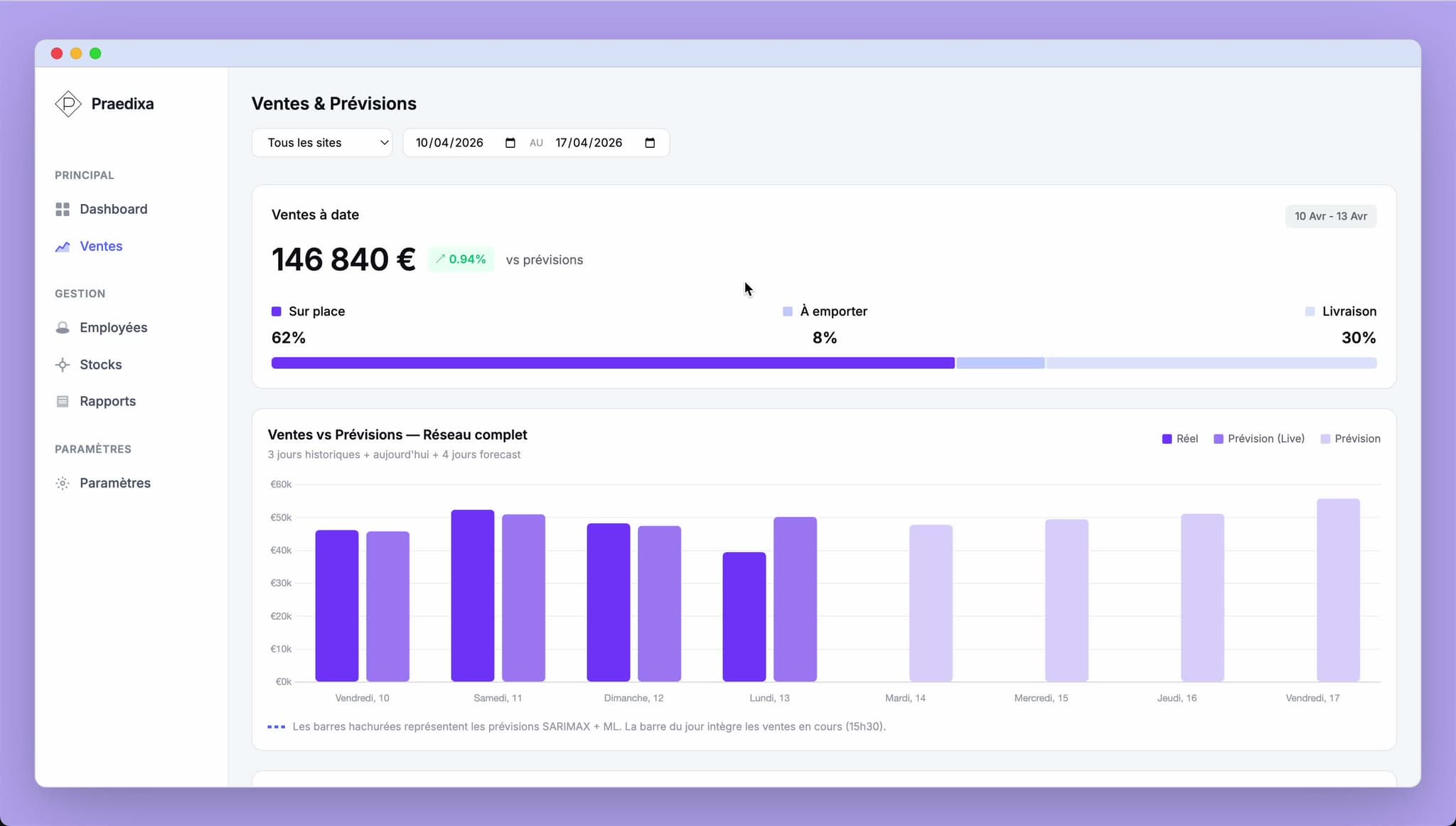
The forecast is not limited to a revenue number. The same foundation can project demand by product, pressure on ingredients, operating load, and staffing needs when recipes, prep times, or service constraints are available from the client environment.
- Features are built without leakage, using only the information that was truly known when the decision had to be made.
- Granularity adapts to data quality: site, product, family, hour, day, or week.
- Forecast outputs are connected to operating needs, not left as isolated numbers on a dashboard.
Model families in practice
Praedixa does not depend on one magic model. Depending on the problem, the granularity, and the amount of history available, the stack combines time-series forecasting, supervised tabular models, and econometric baselines to balance robustness, readability, and predictive performance.
In practice, Forecasting baselines and econometric views remain useful reference points, while gradient boosting and related tabular approaches handle the non-linear interactions between weather, calendar, site, and product. More advanced combinations are only justified when they improve decision quality, not when they merely sound more sophisticated.
- Simple baselines first: seasonality, history-aware rules, conditional averages, and the heuristics already used by operations.
- Machine learning next when it captures cross-effects, heterogeneity, and demand patterns that simple rules miss.
- Model selection or ensembles by segment when one global model would degrade specific sites, families, or operating contexts.
Validation, backtesting, and useful metrics
The standard is not purely predictive. Models are validated with walk-forward backtests, using splits that match the real operating sequence, and are compared against clear operational baselines before being trusted.
The scorecard does not stop at average error. Praedixa also looks at stability by site, behavior on peak days, and the downstream effect on stock-outs, waste, material cost, or staffing because a lower error can still lead to worse economic decisions.
- Walk-forward backtesting to simulate real use over time.
- Systematic comparison against a baseline the client could actually run, not only against another complex model.
- Segment-level review on atypical days, strong weather shifts, promotions, peak load, low-history sites, and low-volume products.
Uncertainty, scenarios, and decision framing
A useful forecast is not just a point estimate. Praedixa also tries to quantify uncertainty, flag fragile contexts, and show what changes when external assumptions move: weaker weather, stronger traffic, a local event, a staffing shortfall, or a capacity constraint.
This is where the product moves beyond isolated forecasting. Scenarios are linked to explicit decision options with visible assumptions: cost of action, cost of inaction, service level, risk, and operating constraints. The goal is to make the trade-off more defensible, not to force an opaque recommendation.
- Uncertainty bands and alert signals when the model knows the context is harder.
- Scenario comparison with both external assumptions and internal constraints kept visible.
- Translation into concrete actions: produce earlier, adjust staffing, secure ingredients, limit a promotion, or accept a measured service risk.
Auditability and improvement loop
Each recommendation or trade-off keeps its context, assumptions, rationale, and observed execution. That trace matters because teams need more than a prediction. They need to understand what was suggested, what was done, and why the outcome moved.
Econometric models help link baseline, chosen decision, and observed impact more carefully through a before / recommended / actual view. The value sits in the full loop: forecast, compare, document, review, and improve the next trade-off.
- Decision logging across predicted state, recommended action, executed action, and observed outcome.
- Cleaner impact attribution so teams can separate context effects, decision effects, and normal operating variance.
- Continuous improvement of features, models, and trade-off rules from measured results and field feedback.